Most couples underestimate one thing: how long everything takes.
The hairstylist runs half an hour over. The car picking you up arrives ten minutes late. Aunt Brigit wants a chat after the ceremony, and suddenly it’s been 45 minutes since you should’ve left for portraits. The day starts calmly and ends in light panic on the way to dinner.
It doesn’t have to be that way.
After photographing 18 weddings, I’ve seen where things slip and how easily they can be avoided. Here’s what I’d tell a couple who asks me about timeline planning.
The most important principle: build in air
The most common mistake is a timeline that’s too tight. Every block takes exactly the time it’s supposed to take, and there’s no buffer between them.
The problem is that reality doesn’t work like that. People chat, transport runs long, someone loses an earring, the groom can’t find his tie clip.
My rule of thumb: leave 15 minutes between every block. If transport is involved, count 30. It sounds like a lot, but I’ve never been at a wedding where the couple said “we had way too much time.” They always say the opposite.
What a typical day looks like
This isn’t the answer key, just a realistic template I’ve seen work many times. Adapt it to your day.
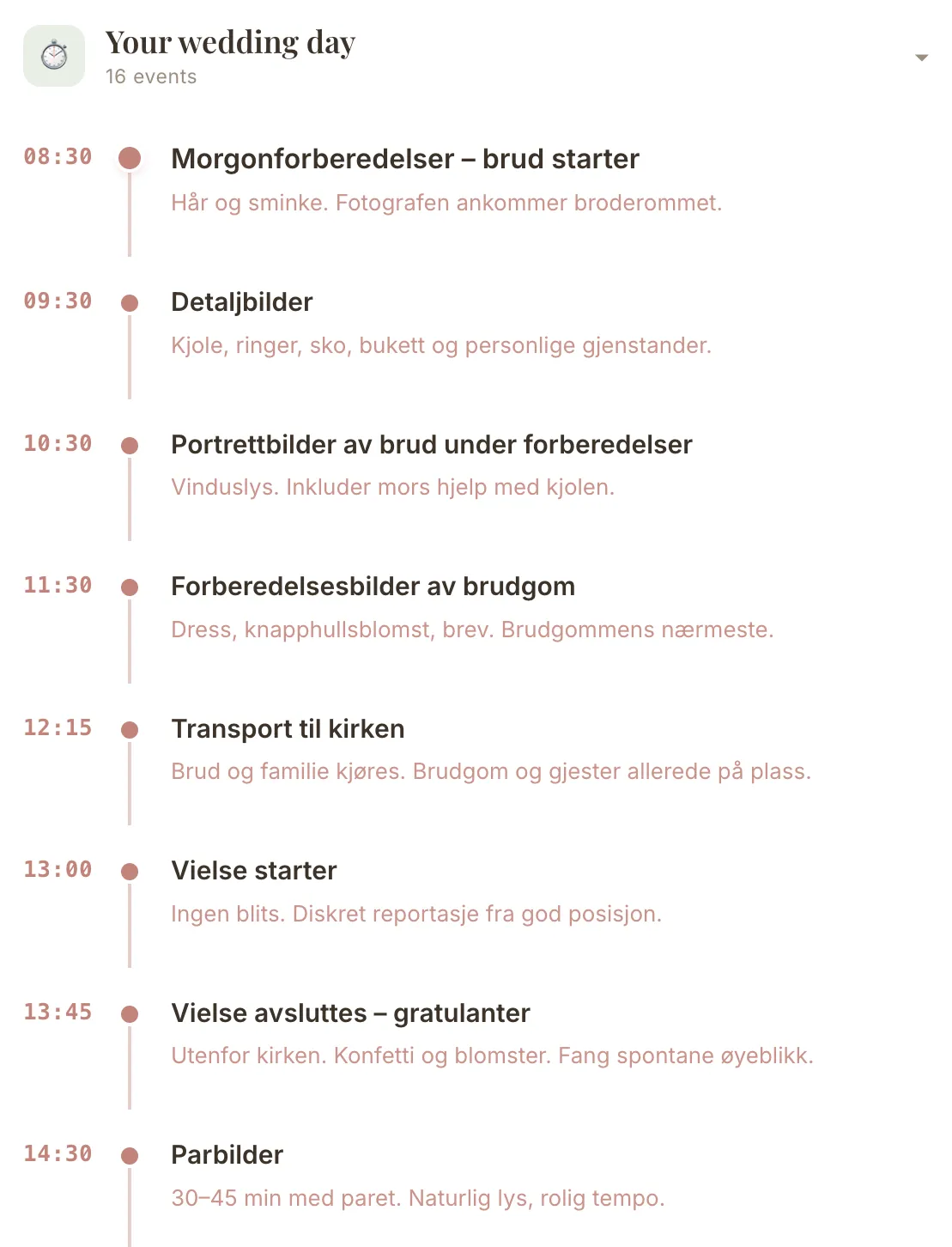 The start of a typical timeline in VowFolio — the tool I use to keep the day on track.
08:00 – Slow morning Breakfast, coffee, music. Don’t skip this. The day will be long, and the energy you start with carries you through.
09:00 – Hair and makeup begins Set aside at least three hours if several of you are getting styled. Hairstylists are almost always optimistic about their own pace. Ask them to be done half an hour before you actually need them to be.
11:30 – Photographer arrives for prep This is where I prefer to start. Details, dress on the hanger, rings, perfume bottle, a glass of champagne with the bridesmaids. The whole story begins here.
12:30 – Bride gets dressed Set aside plenty of time. The buttons on the back of the dress take longer than you think.
13:00 – First look (optional) If you’re considering seeing each other before the ceremony, I’ve written about it in a separate post on first look. Short version: it gives you more time for portraits and calms the nerves. But it’s not for everyone.
14:00 – Ceremony Be in place at least 20 minutes early. Breathe. It goes faster than you think.
14:45 – Congratulations Count on 30 to 45 minutes. Everyone wants a hug and a photo. Don’t try to cut this short. It’s one of the loveliest parts of the day.
15:30 – Family portraits and couple portraits Family portraits take between 15 and 30 minutes depending on how many groupings. Make a list in advance and give it to a bridesmaid or groomsman who can call out names. It saves an enormous amount of time.
For portraits of just the two of you: 45 minutes is fine. An hour is better. That gives us a few different locations and you time to settle between each.
17:00 – Reception and mingling Bubbles, small talk, canapés. You finally get to talk to your guests.
18:00 – Dinner Plan three to four hours with speeches between courses. If you have many speeches, talk to the toastmaster about spacing them so the food doesn’t go cold.
21:30 – Cake cutting A good visual moment and a natural pause before the dancing.
22:00 – First dance Everyone gathers. The lights dim. This is often one of the most emotional images from the day.
22:30 – The party starts in earnest
Light matters more than you think
A tip you won’t get from your wedding planner: think about where the sun is when.
In the middle of the day, light is harsh. Shadows go deep, eyes go dark, skin often takes on a pale tone. It’s not impossible to shoot in, but it’s not where the photos turn out most beautiful.
The last hour before sunset — what photographers call golden hour — is worth its weight in gold. Literally. If you can fit in 20 minutes of portraits just before dinner, when the light is at its softest, you’ll get photos that look completely different from the rest of the day.
Check when the sun sets on your date and build the day around it. In June in Norway, it’s late. In September, around 19:30. That affects when dinner should start.
The five most common mistakes
After 18 weddings, these are the patterns I see again and again:
Too little time at the hairstylist. Book an extra hour beyond what you think you need.
Too little time between ceremony and dinner. Congratulations, transport, family portraits and couple portraits all need to happen here. Two hours is the minimum. Three is better.
Family portraits without a plan. Without a list, everyone wanders around while someone tries to remember whether Aunt Liv was here or not. Make the list before the day, give it to a loud friend, and decide in advance where it’ll happen.
Forgetting to eat. It sounds trivial, but it’s the most common thing I see. The couple is too busy and excited to eat breakfast, and suddenly it’s 3 PM and blood sugar is gone. Eat. Even when you’re not hungry.
No plan B for weather. We live in Norway. If the day is built around outdoor portraits and it pours, you need to know the alternative. Talk to your photographer about this well in advance — it’s one of the questions I recommend asking before you book.
The toastmaster is your best friend
The one person who can really save your timeline is a good toastmaster. Not because they need to be funny between speeches, but because someone has to hold the thread while you’re just present.
Pick someone who dares to be a little strict. Someone who’ll call the chef and check how far off the main course is. Someone who pushes people along when speeches drag. Someone who makes sure you get out for portraits before the light is gone.
Give the toastmaster a copy of the timeline, walk through it together, and hand them the responsibility. Then you don’t have to be project managers at your own wedding.
How you share the timeline matters less than you think
Couples sometimes ask whether the timeline needs to be in a particular format. Word, PDF, Notion, Google Docs, a shared Apple Note, or for that matter a message on Messenger — it all works. What matters isn’t that it’s printed or polished. What matters is that you, the toastmaster and the photographer all have access to the same version, and that it can be updated if something changes the week before.
I’ve seen timelines that were tight Excel tables and timelines that were a handful of bullet points sent by text. Both have worked. Choose what you can actually keep updated.
In closing
A good timeline isn’t about control. It’s about making room for the day to flow. When the structure is in place, you can be present in the moments instead of stressing over the next item on the schedule.
That’s the paradoxical truth about a wedding day: the better planned, the more relaxed it feels.
Good luck.
Wondering how your day should look? I love helping couples plan their timeline well before the wedding. It costs nothing and makes my job better when the day comes. Get in touch if you want to chat.